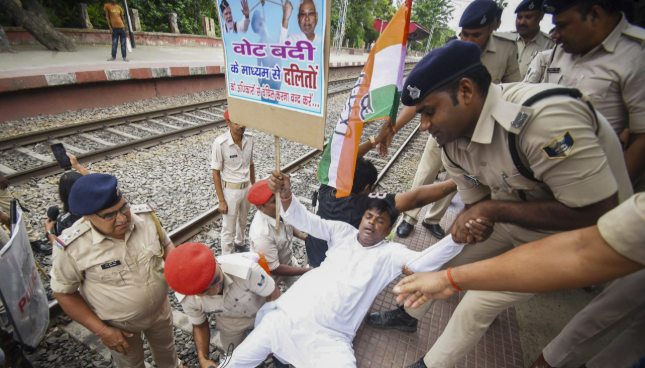
Police hold a demonstrator during an INDIA bloc protest against Special Intensive Revision in Patna, Bihar, July 9, 2025. Photo: PTI While announcing the Special Intensive Revision (SIR) of the electoral rolls in June 2025, the Election Commission of India (ECI) stated that the exercise had become necessary for several reasons, including “rapid urbanisation” and “frequent migration” over the past 20 years. It said that substantial changes had occurred in the electoral rolls because of large-scale additions and deletions.
Yet as the exercise has moved from one state to another in three phases over the last year – the 'pilot' in Bihar, followed by the SIR in 13 more states and Union Territories, then
the ongoing third phase across 19 states and Union Territories – the rules have continued to evolve.
While in the first phase in Bihar, the SIR required electors to complete enumeration forms and submit documentary evidence of their eligibility, in the second phase, carried out in 10
states and three Union Territories, voters were required to link themselves to the 2002 electoral rolls when the previous SIR had been conducted.
In the third phase, currently underway in 19 states and Union Territories, voters are required to link themselves to the electoral rolls from the earlier SIR exercise, conducted roughly two
decades ago. It also requires new voters to register themselves through Form 6 to link their parents’ details to the previous SIR exercise.
we examines how the voter roll revision exercise has implemented varying rules as it has progressed since 2025:
Phase 1 in Bihar: Enumeration forms and documentary proof
The pilot SIR exercise in Bihar required voters to fill enumeration forms and provide one of 11 documentary proofs for their inclusion in the voter rolls.As per the ECI’s instructions, the enumeration form required that those born before July 1, 1987 would have to prove their date and/or place of birth. Those born between July 1, 1987 and December 2, 2004 would have to prove their date of birth and the date/place of birth of one of their parents. And those born after December 2, 2004 would have to prove their date/place of birth as well as that of both their parents.
The list of 11 indicative documents that the ECI said could be provided as documentary proof for inclusion in the rolls included birth certificate, passport, matriculation certificate, permanent residence certificate issued by a state authority, forest rights
certificate, caste certificate, a National Register of Citizens entry, a family register prepared by a state or local authorities, any land or house allotment certificate issued by
the government, any identity card or pension payment order issued to a regular employee or pensioner of a Union government or state government or public sector
undertaking, or any such identity card, certificate or document issued by the government or local authorities including banks, post offices, LIC or Public Sector Unit
prior to July 1, 1987.
Despite the Election Commission’s flip flops and resistance, after the Supreme Court's intervention, Aadhaar card was added as the 12th document that could be used for identification. It has reported that during the Bihar SIR itself, the Election Commission changed course, through timelines, documents and rationale, including the rules governing the submission of enumeration forms, the SIR's rationale, as well as the deadline for people to file claims and objections. Phase 2: Mapping to previous SIR roll In the second phase, announced in October last year, the SIR was held in Goa, Puducherry, Chhattisgarh, Gujarat, Kerala, Madhya Pradesh, Uttar Pradesh, Rajasthan, West Bengal, Tamil Nadu, Andaman and Nicobar Islands and Lakshadweep. While Chief Election Commissioner Gyanesh Kumar had said that voter rolls are revised before any election, the poll body decided to leave out Assam from the SIR exercise, though it also went to the polls in 2026, while it included West Bengal, Tamil Nadu, Kerala and Puducherry. In this phase, the Election Commission, unlike in Bihar, said that no documents would be required to be furnished in the house-to-house verification phase of the SIR and the collection of enumeration forms phase. Instead, voters were required to be mapped to the previous SIR – either by providing their own details if they were a voter in the last SIR (held in 2002-04) or by entering the details of their parents who were then electors. This phase also saw the creation of a new category called logical discrepancy, under which name mismatches due to errors or variations in spellings or errors in translation from the vernacular resulted in voters being flagged for non-inclusion. In West Bengal, over 27 lakh voters were unable to vote in the assembly elections held in April, with their appeals pending a hearing by judicial tribunals
Phase 3: Role of Form 6 and revision prior to polls In the third phase of the SIR, announced in May 2026, the Election Commission has included Andhra Pradesh, Arunachal Pradesh, Chandigarh, Dadra and Nagar Haveli and Daman and Diu, Haryana, Jharkhand, Karnataka, Maharashtra, Manipur,
Meghalaya, Mizoram, Nagaland, NCT of Delhi, Odisha, Punjab, Sikkim, Telangana, Tripura and Uttarakhand. While voters are being required to map their details or their parents' details to the previous SIR, Form 6, which is used for enrolling new voters, has also come into focus in this phase. In its instructions for Bihar, the Election Commission requires new voters to provide a declaration, including documentary proof, of the 11 indicative documents it is accepting. During phase one, the instructions were that if any elector in Bihar was unable to fill their enumeration form in time, they may submit Form 6 during the claims and objections period along with the declaration. Since the second phase in October, the Form 6 for enrolling new voters also requires mapping voters to their parents’ SIR details in the previous SIR, if the form is filled online. This change has been made though no amendment to the Form or Gazette notification has been issued to this effect, the Indian Express has reported. If the form is downloaded, this new step is not required. Further, in the case of Bihar, the Election Commission had said that the SIR was necessary before elections, while Chief Election Commissioner Gyanesh Kumar had himself said before announcing the second phase in October that it was necessary to revise the rolls before polls, none of the states undergoing the SIR in its third phase are going to the polls this year. Uttar Pradesh (which completed the SIR earlier this year) will go to the polls late next year while Punjab and Uttarakhand, which will have elections in early 2027, are undergoing the SIR now.